

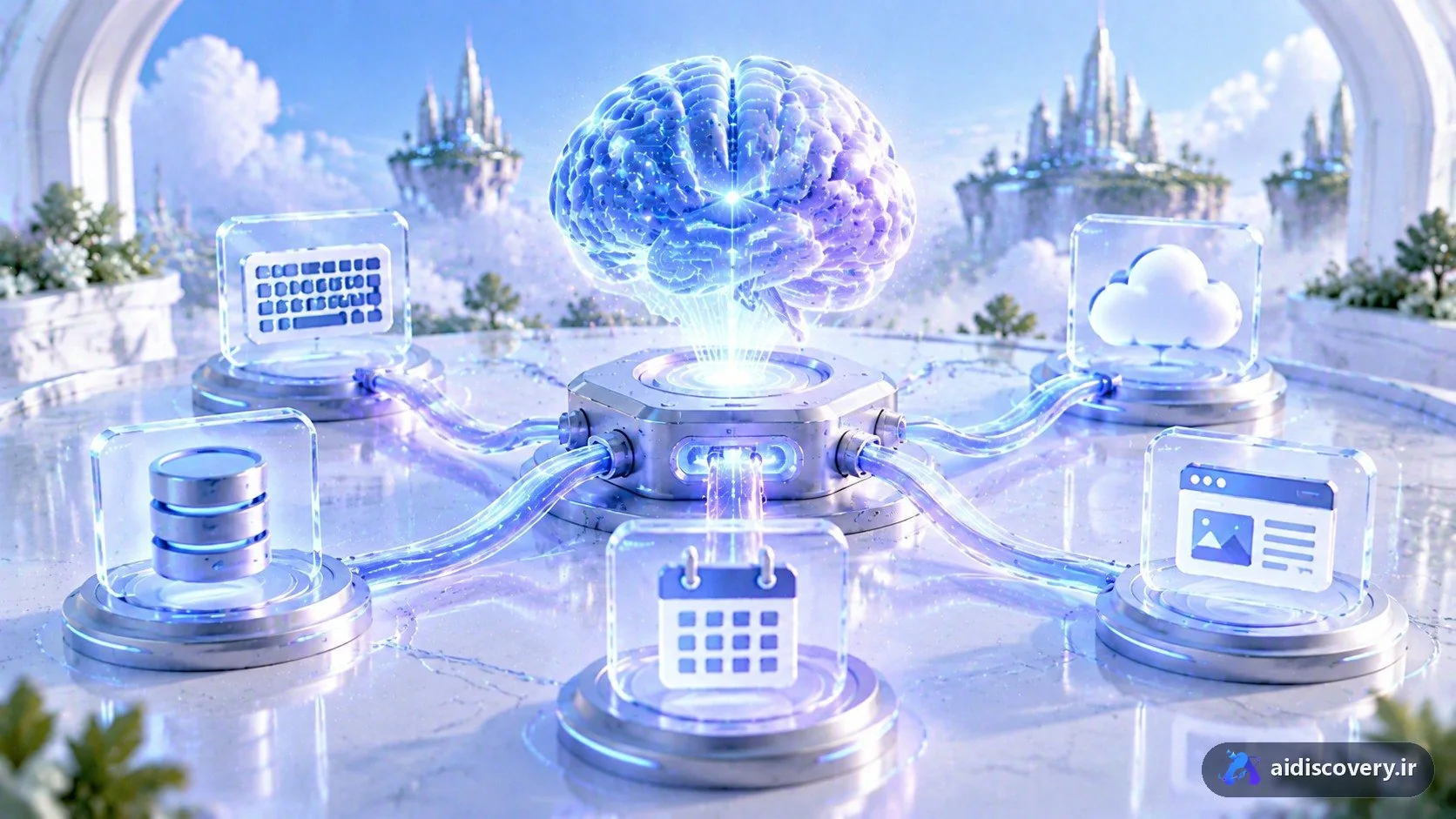
The problem MCP solves
Before MCP, every AI application had to build a custom connection to every data source — files, databases, GitHub, Slack. It was the pre-USB-C world where every device shipped its own cable. The Model Context Protocol is an open standard: a tool advertises itself via MCP once, and every compatible application can use it.
Three roles in the architecture
- Host: the application the user works in — say, a code editor with an AI assistant.
- Client: a connector inside the host that keeps a one-to-one session with each server.
- Server: a small program that exposes one source's capabilities in the standard format.
One application can talk to many servers; servers stay independent of each other.
Three kinds of capability
- Tools: actions the model can execute (create an issue, run a query, send a message).
- Resources: data the model can read (files, records, content).
- Prompts: ready-made templates the server author defines for common tasks.
Why it matters
For users: your AI assistant connects to everyday tools with no per-app setup. For developers: instead of ten custom integrations, you write one standard implementation that works everywhere. For security: the trust boundary is explicit — the server decides what is visible and executable, and the client asks the user for consent.